


Table of contents
- Checking the deceased's documents (debts) – this will help decide whether to accept or reject the inheritance
- Confirmation of inheritance rights
- Reporting to the Tax Office and updating the Land and Mortgage Register
- Decision on selling or renting (taking PIT into account)
Confirmation of inheritance rights
The process of confirming inheritance rights comes down to obtaining a document that officially indicates who inherited the deceased's assets and in what shares. Without it, you cannot transfer utility meters, update the Land and Mortgage Register, or sell the apartment.
Determining the basis of inheritance
Testamentary inheritance: The deceased left a valid will (handwritten or notarial). If you are unsure whether such a document exists, any notary can check the Notarial Register of Wills (NORT) based on the death certificate.
Statutory inheritance: No will (or its rejection/invalidity). In this case, the Civil Code determines the order of inheritance (first in line are the spouse and children in equal shares, with the spouse's share being no less than 1/4).
Decision to accept or reject the inheritance (6 months)
From the day you learned about your entitlement to the inheritance (usually the day of your loved one's death), you have 6 months to submit a declaration before a notary or court:
Acceptance with the benefit of inventory (default option): If you do nothing for 6 months, you inherit this way automatically. You are liable for any debts of the deceased only up to the value of the inherited assets (e.g., the value of the apartment).
Simple acceptance: You take the assets along with full responsibility for debts (without limits). Rarely used.
Rejection of inheritance: You are treated as if you did not live to see the opening of the inheritance (your share passes to the next people in line, e.g., your children – in which case a declaration must also be submitted on their behalf). Chosen when debts exceed the value of the apartment.
Obtaining an official document
OPTION A: At a notary (Deed of Certification of Inheritance – APD) The fastest route – you settle the matter during a single visit, and the document is valid immediately after the notary registers it in the Inheritance Register.
When it can be used: All potential heirs (both statutory and testamentary) must appear before the notary simultaneously and be 100% in agreement regarding the division and validity of the will.
Required documents: Abridged copy of the death certificate, certificate of the deceased's PESEL number (issued by the municipal office), copies of the heirs' birth certificates (for married women – marriage certificates), the original will (if any), and the Land and Mortgage Register number of the apartment.
OPTION B: In court (Confirmation of acquisition of inheritance) The necessary route wherever a notary's hands are tied.
When it must be used:
There is a conflict among the heirs (e.g., someone challenges the will).
One of the heirs has passed away (and there are no documents for them), cannot be contacted, or lives abroad and cannot come to the notary.
A special will is involved (e.g., an oral will).
How it works: You file an application for confirmation of acquisition of inheritance with the district court competent for the deceased's last place of habitual residence. You attach the same civil status records as at the notary's office, plus copies of the application for each participant. After the hearing, the court issues a decision, which becomes final after 7 days (if no one requests a written justification/files an appeal).
We accepted the inheritance – what now?
After obtaining the Deed of Certification of Inheritance or a final court decision, the heirs are already the formal owners of the apartment, but the deceased person is still listed in public registers and with utility providers. Here is the exact sequence of actions you need to take now:
Reporting the inheritance to the Tax Office (Crucial 6 months)
Immediate family (the so-called zero group): Spouse, descendants (children, grandchildren), ascendants (parents, grandparents), stepchild, siblings, stepfather, and stepmother are completely exempt from inheritance tax. The condition is submitting the SD-Z2 form within 6 months from the date the deed was registered at the notary or the court ruling became final (this can be done online via e-Urząd Skarbowy). Being late by even a single day means losing the exemption and having to pay the tax.
Registering the new owner in the Land and Mortgage Register (KW)
The entry in the Land and Mortgage Register does not update automatically after visiting a notary or probate court – you must submit a separate application, because without it, selling the apartment will be difficult.
How to do it: At the district court (the land and mortgage register division competent for the apartment's location), you submit the KW-WPIS form (filled out jointly for all co-owners, listing their shares).
You attach an extract of the Deed of Certification of Inheritance or a copy of the final court decision, along with proof of payment of the court fee.
Housing cooperative, municipality, and transferring meters
Housing cooperative or condominium association: Present the document confirming the inheritance and submit a declaration on the number of people living in the premises (if the apartment stands empty, garbage fees or water advance payments will drop).
Property tax (City/Municipal Office): Within 14 days of confirming the acquisition of inheritance, you must submit information on real estate and building structures (form IN-1), based on which the municipality will calculate the new property tax.
Utility providers (electricity, gas, internet): With the inheritance document and recorded meter readings, visit the providers (or do it online) to transfer the contracts to your name or terminate unnecessary ones (e.g., cable TV).
Decision: sell or rent (Watch out for PIT tax)
Renting: The apartment can be rented out immediately, or you can consider refreshing or renovating it.
Selling and the 5-year rule: Exemption from inheritance tax (SD-Z2) does not exempt you from income tax (19% PIT) in the case of a quick sale. You will not pay PIT if 5 full calendar years have passed since the end of the calendar year in which the deceased (testator) acquired or built the apartment. If 5 years have not yet passed, the only way to avoid the 19% tax is to spend the proceeds from the sale on your own housing purposes (e.g., buying another apartment, renovating your own house, or paying off your own mortgage) within 3 years.
Preparing the apartment
Depending on whether you plan to sell or rent, it is worth refreshing the apartment; you don't need to strain your budget heavily to "upgrade" the property. Sometimes tidying it up, repainting, and adding a few elements like paintings or plants is enough. Thanks to this, you will find interested parties faster and be able to get a better price. If you don't know how to decorate the apartment, you can take a photo and ask Google's Gemini to prepare an interior design in your preferred style, though keep in mind whether the suggested furniture is actually available on the market, and remember it won't replace the work of a professional designer.
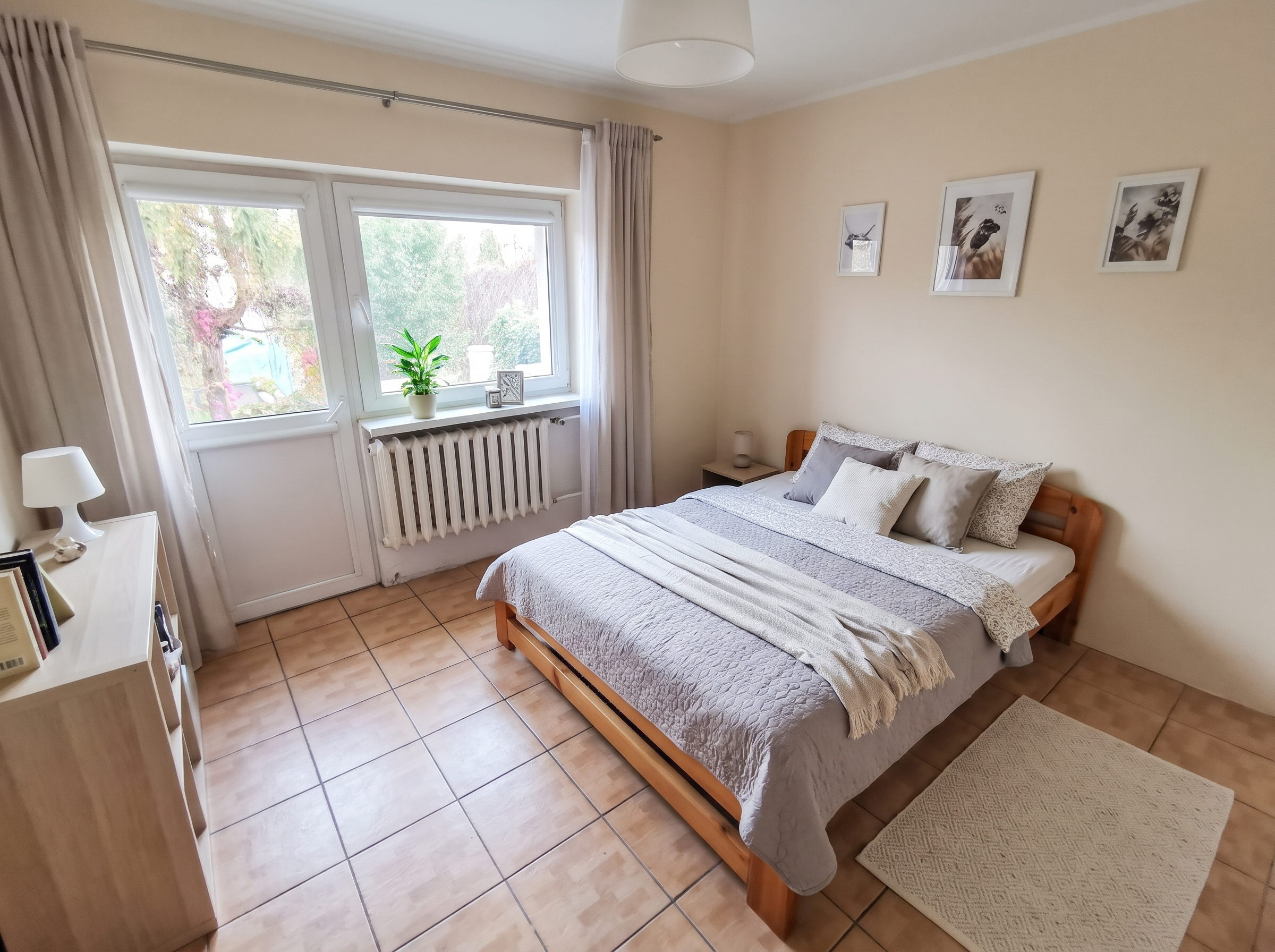
 BeforeAfter
"They left loans and debts" – what to do?
We often encounter situations where people accept an inheritance along with debts because the property was worth more, and until they sell or rent it out, they pay off the debts out of their own pocket. Does it really have to be that way?
Check documents in the apartment
This is the fastest step to start with. It will help you find out which banks the deceased had cards, loans, or debts with. Additionally, you might find a life insurance policy that could cover the mortgage.
Check the physical and electronic mailbox
For the first few weeks, regularly check the mailbox at the apartment, as some invoices and payment reminders arrive only once a month.
Terminate phone, internet, and TV contracts
Report the death to telecom operators – by presenting the death certificate, you can easily terminate landline, mobile phone, internet, or cable TV contracts, avoiding further subscription charges.
You don't need to wait for probate proceedings to do this.
Send an inquiry to BIK
BIK (Credit Information Bureau) protects banking secrecy, so it will not provide any information based solely on a death certificate. You can submit an inquiry only after obtaining a Deed of Certification of Inheritance from a notary or a final court decision confirming the acquisition of inheritance.
The report will show all active and historical liabilities of the deceased in institutions cooperating with BIK, including:
- mortgage loans (which helps identify which bank holds an entry in the apartment's Land and Mortgage Register),
- cash and consolidation loans,
- credit card limits and account overdrafts,
- installment purchases and most non-bank loans (payday loans).
Request payout of funds from bank accounts
Aside from debts, the deceased often had funds in their bank account.
Withdrawing inherited funds is possible only after formal confirmation of inheritance rights. At the bank branch, you must present:
Inheritance document: an extract of the Deed of Certification of Inheritance (from a notary) or a copy of the final court decision confirming the acquisition of inheritance.
Heir's identity document (ID card or passport).
The account number to which the bank should transfer the inherited funds. During the same visit, immediately request the closure of the accounts whenever possible.
Insurance policies
Insurance policies and more – below is what can help you financially in such a situation
Life insurance policy assigned to the bank (for a mortgage)
If the apartment is encumbered with a mortgage, the bank almost always requires taking out such a policy and assigning it to the bank (designating the bank as the entity entitled to receive the payout). Upon the borrower's death, the insurer pays off the remaining loan principal – in full or proportionally to the deceased's ownership share. As a result, heirs take over the apartment debt-free (or with a much lower debt) and can apply to the bank for consent to delete the mortgage from the Land and Mortgage Register. (Note: check the General Terms and Conditions (OWU) for liability exclusions).
Individual life insurance policy (with a designated beneficiary)
Works on completely different rules than regular inheritance. Under the Civil Code, money from such a policy does not enter the estate, but goes directly to the person designated in the contract as the beneficiary. This means three huge benefits:
Fast payout: No need to wait for a notary or probate court – the insurer pays out the funds upon submission of the death certificate and the beneficiary's ID.
No tax: The payout is exempt from both inheritance and gift tax and income tax (PIT) – even if the beneficiary was unrelated.
Protection against debts: Even if the deceased had debts, creditors cannot seize money from a policy paid out to a designated beneficiary. (Exception: if the deceased did not designate anyone in the policy, the payout enters the estate under standard rules).
Group insurance at work (so-called "grupówka")
Very popular in Poland – covers not only the death of an employee (often with a higher payout in case of an accident), but frequently also the death of a spouse or parents.
NNW insurance and packages bundled with bank accounts and credit cards
If death occurred as a result of an accident (e.g., a traffic accident), compensation may be due from an individual personal accident (NNW) policy, travel insurance, or insurance bundled with a personal bank account or credit card.
Don't forget about PPK, IKE, IKZE, and OFE
None of these institutions will pay out money automatically. To claim these funds, the entitled person or spouse must independently submit an application to the specific institution.
Power of attorney – how it can help
A power of attorney is one of the most practical tools when inheriting an apartment – especially when there are several heirs, they live in different cities (or abroad), or one person takes on the entire burden of formalities and preparing the property for sale.
One representative for offices and utilities
Instead of several people taking time off work, you designate one family member who handles matters on behalf of everyone at the housing cooperative, municipal office, electricity and gas providers, or the land and mortgage register court.
Smooth remote sale of the apartment
If one of the co-owners lives abroad or on the other side of Poland, they do not have to travel to sign the notarial deed of sale (or earlier for the preliminary agreement). They can grant a power of attorney to another heir, who will sign the sale on their behalf.
Withdrawing funds from the bank
Banks usually require the simultaneous presence of all heirs. An appropriate power of attorney allows one person to withdraw funds and close the deceased's accounts.
Managing rentals and renovations
The attorney-in-fact can sign a lease agreement on behalf of the co-owners, hand over keys, supervise a renovation crew, or collect correspondence regarding the property.
| Form of power of attorney | What is it sufficient for? | Cost |
|---|---|---|
| Simple written form (hand-signed) | Housing cooperative/condominium association, transferring utility meters (electricity, gas, internet), collecting civil status records at the Registry Office (USC), representation in probate court (when the proxy is immediate family). | 0 – 17 PLN |
| With notarized signature | Withdrawing money from the deceased's account and closing bank accounts, submitting an inquiry to BIK, certain official formalities. | approx. 40 PLN gross at a notary |
| Notarial deed (special power of attorney) | Mandatory for selling an apartment, preliminary agreements in the form of a notarial deed, and notarial division of inheritance. | approx. 130 – 380 PLN gross at a notary |
Bailiff's inventory vs. private list of inventory
When inheriting an apartment with the benefit of inventory, you are liable for any debts of the deceased only up to the value of the inherited assets. To formally establish this limit, you can file a self-completed list of inventory in court (free of charge) or at a notary. However, if you suspect your loved one had hidden debts or you anticipate claims from creditors, a safer solution is to commission an inventory list from a court bailiff (the fixed fee is approx. 492 PLN gross plus a possible property valuation by an appraiser). The bailiff will officially determine the value of the real estate and uncover liabilities in banks or public offices, giving you solid legal protection.
I am inheriting as "extended family" – how do I report the inheritance to the Tax Office?
Extended family and non-relatives: Submit form SD-3 within 1 month from the date the tax obligation arose and wait for the tax office's decision determining the amount of tax.
Why do I need to submit form IN-1 at the City/Municipal Office?
Form IN-1 is used by the municipality or city to calculate the annual property tax and transfer it from the deceased to you as the new owner. A notary does not do this. You have 14 days to submit it from the date the APD (Deed of Certification of Inheritance) is registered at the notary.
What is the notary's role in this process?
After drawing up the Deed of Certification of Inheritance (APD), the notary registers it in the IT system (Inheritance Register), sends an extract of this deed to the relevant head of the tax office, and optionally, for an additional fee, submits an application on your behalf to the land and mortgage register court (registering you as the new owner in the Land and Mortgage Register).
How do I find out what debts the deceased had?
Documents, mail, and phone: Review bank statements, loan agreements, correspondence from debt collection agencies, bailiffs, or offices (ZUS, Tax Office), as well as the deceased's SMS/email history.
Information on bank accounts (Central Information): With a death certificate, you can submit an inquiry at any bank or credit union (SKOK) to find out which institutions held accounts for the deceased. You won't immediately learn the debt balances there (for that, you need a Deed of Certification of Inheritance or a court decision), but you will find out which banks to contact.
Talking to loved ones: Conversations with family or friends often reveal private loans that leave no trace in banks.
Do I have to accept the inheritance right away?
No, you don't have to. You have 6 months to make a decision from the day you learned about your entitlement to the inheritance (for immediate family, this is usually the day of the testator's death).
Where should I look for the deceased's insurance policies?
In Poland, there is no central register of life insurance policies (the Insurance Guarantee Fund only collects data on motor third-party liability OC and comprehensive AC policies). If the family does not know the insurance details, you need to conduct a small investigation in 5 places: Bank account history (the most effective method): After gaining access to the deceased's bank statements, review outgoing transfers and standing orders from the last 12 months. Regular payments (monthly, quarterly, or annual) to insurance companies (e.g., PZU, Warta, Nationale-Nederlanden, Allianz, Generali, Prudential, Unum) almost always include the policy number in the transfer title. Home documents and mailbox: Insurers send an annual policy anniversary summary or premium indexation proposal by post – even if the policy was taken out many years ago. Email inbox and text messages: Searching the deceased's email for keywords such as "polisa" (policy), "ubezpieczenie" (insurance), "składka" (premium), "OWU" (terms and conditions), or "uposażony" (beneficiary) often immediately reveals electronic confirmations of the contract. HR department at the deceased's workplace: If your loved one was professionally active (or retired and continued group insurance individually), the HR department will provide information on which insurer holds the company's group policy. The bank financing the apartment: The mortgage agreement contains a clause regarding required life insurance, and the bank keeps a copy of the policy along with the assignment in its records.
Writes about the property market, law and financing.
Looking for your first flat?
Filter listings from owners and buy with no commission.
Browse listings from owners